Staghorn & elkhorn ferns
Family: Polypodiaceae | Genus: Platycerium
Habitat and cultivation
Platycerium grow on trees, rocks and cliff faces, from humid rainforest to more open vegetation. With protection, they adapt to temperate climates, although they prefer warmer conditions. They can be grown on trees or boards, or in pots and hanging baskets.
An open mix, rather than garden soil
For pots and baskets, use a good, open epiphyte mix. For slab mounting, a small amount of mix and sphagnum moss can be placed behind the fern pad before it is firmly secured to the board. These ferns are not grown in ordinary garden soil.
Water and feed with the seasons
Water regularly during warmer months in temperate climates, then reduce watering in winter. Garden plants may receive sufficient rainfall during cooler months. Use a little well-rotted manure during warm growing periods, or an occasional weak liquid feed. Slow-release fertilisers may also be used sparingly.
Match the light to the species
In temperate climates, P. bifurcatum tolerates bright light and some established plants grow in full sun for part or most of the day. In exposed positions, adequate moisture and shelter from strong winds are important. P. superbum prefers more shade. Delicate varieties suit shade houses, glasshouses or covered patios, where light and moisture can be controlled.
Check for pests
Inspect plants for mealybug and coconut scale. Avoid feeding with banana skins, which attract cockroaches and slaters. Elkhorn tip moth larvae can tunnel through the spore patches (sori) of P. bifurcatum, causing frond tips to brown and dry, particularly in warmer months.
For pest treatment, seek current advice for the identified pest. The original article’s named pesticide treatments have been omitted from this draft pending review.
Species and cultivars
Platycerium bifurcatum | Elkhorn Fern
A clumping temperate-to-tropical epiphyte from Australia, New Guinea, New Caledonia, Lord Howe Island and parts of Indonesia. Common in cultivation, it adapts to varied climates and has many forms and hybrids.
“Netherlands” has relatively short, arching, deeply lobed fronds with narrow, drooping segments and a bluish-grey appearance. The form described in the original as P. bifurcatum var. willinckii comes from subtropical and tropical Indonesia and New Guinea. Its fronds are long and pendulous, and it is cold-sensitive in temperate cultivation.
Platycerium hillii
An Australian clumping epiphyte of subtropical and tropical areas. Its erect fronds are pale green to grey, and it is cold-sensitive. The cultivar “Drummond” has very broad fertile fronds, with the apex divided into ten or more segments.
Platycerium veitchii | Silver Elkhorn
An Australian clumping subtropical-to-tropical fern that naturally grows on boulders and cliff faces exposed to hot sun. In temperate cultivation, protect it from cold, wet days and nights and keep it fairly dry in winter. Although slow-growing, it grows well under eaves or Perspex, or in a hothouse with bright light but no direct sun. Plants have a greyish-white appearance.
Platycerium superbum | Staghorn Fern
An Australian non-clumping temperate-to-tropical epiphyte. This beautiful fern grows well in temperate cultivation when kept drier in winter. It prefers dappled light and protection from strong winds.
Propagation
P. bifurcatum can be propagated by spores or division. P. superbum is propagated by spores. Tissue culture is also used for some Platycerium species and cultivars.
Mounting and remounting
Choose a lasting support
Use weathered jarrah or another suitable hardwood, preferably old or recycled, secured to a wooden or metal frame. The original recommends avoiding pine, including treated pine. If mounting on a living tree, avoid trees that naturally shed their bark.
Mounting an elkhorn
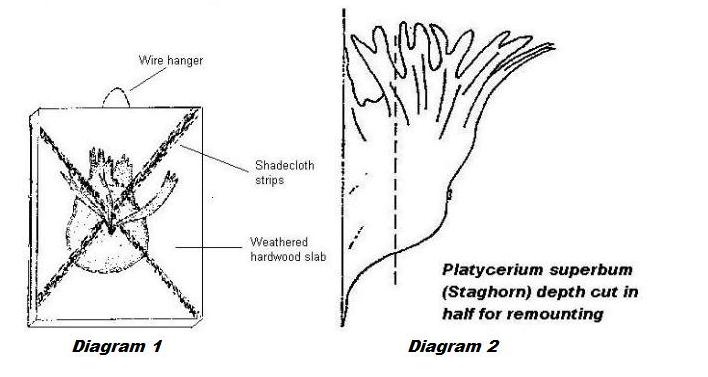
Place the fern pad flat against the board, with the growth eye protected. A little epiphyte mix or sphagnum moss may be placed behind the plant. Fasten with 25 mm-wide strips of shadecloth, preferably knitted, secured with heavy-duty staples, screws or bolts. Keep strips clear of the growth centre and avoid gaps between the pad and board.
As the plant grows, it will cover the strips, which can hold it in place for years. Elkhorns can also be grown in hanging baskets, eventually forming a ball.
Remounting a staghorn
P. superbum is a single, non-clumping plant and cannot be divided like an elkhorn. Diagram 2 shows reducing the depth of an old pad for remounting, not dividing the fern into two plants. Keep the pad flat against its new board and secure it with shadecloth strips, protecting the growth centre.
Before cutting an established pad or removing an elkhorn pup, ask an experienced grower to demonstrate the method. The original cutting measurements need clarification before being used as step-by-step instructions.